|
Our Patron
Also
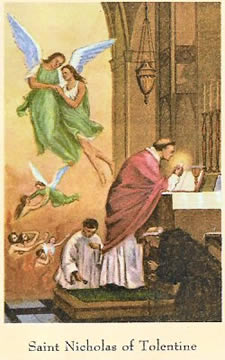
known as Patron of Holy Souls
1245
at Sant'Angelo, March of Ancona,
diocese of Fermo
September
10, 1305 at Tolentino, Italy following a long
illness; relics rediscovered at Tolentino in 1926;
in previous times they were known exude blood
when the Church was in danger.
5
June (Pentecost) 1446 by Pope Eugene IV; over
300 miracles were recognized by the Congregation
Souls
in Purgatory, animals, babies, boatmen, dying
people, mariners, sailors, sick animals, watermen
Augustinian
giving bread to a sick person;
Augustinian holding a container of bread;
Augustinian holding a container of money;
Augustinian holding a lily;
Augustinian holding crucifix garlanded with lilies;
Augustinian with a star above him;
Augustinian with a star on his breast;
basket with bread rolls;
crucifix garlanded with lilies;
lily
"The
Heavens are not pure in the sight of Him Whom
I serve; how then shall I, a sinful man, stand
before Him?"
Biography
ST. NICHOLAS
OF TOLENTINO, CONFESSOR {1245- 1305} or {1306-1246}
Born at
-- Sant' Angelo, in Pontano, near Fermo, in the March of Ancona
His parents,
said to have been called Compagnonus de Guarutti and Amata de Guidiani
(these surnames may merely indicate their birth-places), were pious
folk, perhaps gentle born, living content with a small substance. His
mother was a model of holiness. They were childless until a pilgrimage
to a shrine of the original Saint Nicholas at Bari, Italy where his
mother asked for a son whom she promised to dedicate to God's service.
When her wish was granted, she named the boy Nicholas. He soon gave
unusual signs of saintliness. Already at seven he would hide away in
a nearby cave and pray there like the hermits whom he had observed in
the mountains.
His religious
formation was greatly influenced by the spirituality
of the hermits of Brettino, one of the congregations which
came to form part of the "Grand
Union" of Augustinians in 1256, whose communities were located
in the region of the March where Nicholas was born
and raised. Characteristic of these early hermits
of Brettino were a great emphasis on poverty, rigorous
practices of fasting and abstinence, and long periods of the day devoted
to communal and private prayer.
After hearing
the inspired preaching by Reginaldo da Monterubbiano,
Prior (local superior) of the Augustinian monastery in
Sant'Angelo, he felt a call to embrace the religious
life. His parents gave a joyful consent. His piousness so impressed the
Bishop of Fermo that he permitted Nicholas to join the minor orders as
young boy. As soon as he was old enough he was received into the Order
of Augustinian friars and made his novitiate in 1261. At age eighteen
he made his profession and entered the monastery at Tolentino where he
was very active in administering the sacraments to the local community.
He quickly won over the trust and love of the locals; he was often called
upon to pray for the deceased loved ones and was affectionately referred
to as the "Patron of Holy Souls".
As Nicholas
entered the Order at its inception he learned to combine the ascetical
practices of the Brettini with the apostolic thrust which the Church
now invited the Augustinians to practice. At times Nicholas devoted
himself to prayer and works of penance with such intensity that it was
necessary for his superiors to impose limitations on him.
At one point
he was so weakened through fasting that he was encouraged in a vision
of Mary and the child Jesus to eat a piece of bread signed with the
cross and soaked in water, to regain his strength.
Nicholas repeated these steps throughout the community
to help the sick, resulting in numerous miracles of
healing. In his honor the custom of blessing and
distributing the "Bread
of Saint Nicholas" is
continued by the Augustinians in many places to this
day including his shrine.
On account
of his kind and gentle manner his superiors entrusted
him with the daily feeding of the poor at the monastery gates, but at times
he was so free with the friary's provisions that the procurator begged
the superior to check his generosity. Even before his ordination he was
sent to different monasteries of his order, at Recanati, Macerata etc.,
as a model of generous striving after perfection.
He was ordained
in 1271 and said his first Mass with exceptional
fervor; thereafter, whenever he celebrated the holy Mystery he seemed
aglow with the fire of his love. He lived in several different monasteries
of the Augustinian Order, engaged principally in the ministry of preaching.
In
1275 he was sent to Tolentino, and remained there
for the rest of his life. He was known for his humility,
meekness and sanctity. His preaching, instructions
and work in the confessional brought about numerous conversions,
and his many miracles were responsible for more,
yet he was careful not to take any credit for these miracles.
"Say nothing of this," he would insist, "give thanks
to God, not to me. I am only a vessel of clay, a poor
sinner."
As a priest
and religious, he was full of charity towards his brother Augustinians
as well as towards the people to whom he ministered. He visited the
sick and cared for the needy. He was a noted preacher of the Gospel.
He gave special attention to those who had fallen away from the Church.
People considered him a miracle worker. He often fasted and performed
other works of penance. He spent long hours in prayer.
Nicholas
worked to counteract the decline of morality and
religion which came with the development of city life in
the late thirteenth century. A fellow religious describes
Nicholas’ ministry
in these words:
"He
was a joy to those who were sad, a consolation to
the suffering, peace to those at variance, refreshment
to those who toiled, support for the poor, and a healing
balm for prisoners."
Nicholas’
reputation as a saintly man and a worker of miracles
led many people to the monastery of Tolentino.
He worked
as a peacemaker in a city torn by civil war. Preached every day, wonder-worker
and healer, and visited prisoners. Received visions, including images
of Purgatory, which friends ascribed to his lengthy fasts. Had a great
devotion to the recently dead, praying for the souls in Purgatory as
he traveled around his parish, and often late into the night.
Reported
to have resurrected over one hundred dead children, including several
who had drowned together. Legend says that the devil once beat Nicholas
with a stick; the stick was displayed for years in the his church. A
vegetarian, Nicholas was once served a roasted fowl; he made the sign
of the cross over it, and it flew out a window. Nine passengers on ship
going down at sea once asked Nicholas' aid; he appeared in the sky,
wearing the black Augustinian habit, radiating golden light, holding
a lily in his left hand; with his right hand he quelled the storm. An
apparition of the saint once saved the burning palace of the Doge of
Venice by throwing a piece of blessed bread on the flames.
He spent
the last thirty years of his life in Tolentino preaching
with wonderful success, where the Guelfs and the Ghibellines
were in constant strife. Nicholas saw only one remedy
to the violence: street preaching, and the success of this apostolic
work was astounding. "He spoke of
the things of Heaven," says his biographer St. Antonine. "Sweetly
he preached the divine word, and the words that
came from his lips fell like flames of fire. Among
his hearers could be seen the tears and heard the
sighs of people detesting their sins and repenting of their past lives."
Towards
the end diseases tried his patience, but he kept
up his mortifications almost to the hour of death. He died
surrounded by his community. He possessed an angelic
meekness, a guileless simplicity, and a tender love of virginity, which
he never stained, guarding it by prayer and extraordinary mortifications.
Many of the cures obtained through Saint Nicholas’ prayers were
received while he himself was infirm.
In 1345
a lay Brother cut off the arms of his body intending to take them to
Germany as relics, and the friars then hid his body to prevent further
attempts of this kind. It has not been found to this day, but the arms
have been preserved. It is recorded that they have bled on several occasions,
usually; it is said, before some calamity that befell the Church or
the world.
When in
1884 Nicholas was proclaimed "Patron of the Souls in Purgatory"
by Pope Leo XIII, confirmation was given to a long-standing
aspect of devotion toward this friar which is traced to an event in his
own life. On a certain Saturday night as he lay in bed, Nicholas heard
the voice of someone who identified himself as Fra Pellegrino of Osimo,
a deceased friar whom Nicholas had known. Fra Pellegrino revealed that
he was in Purgatory and begged Nicholas to offer Mass for him and for
other suffering souls so that they might be set free. For the next seven
days Nicholas did so and was rewarded with a second vision in which the
deceased confrère expressed his gratitude and assurance that a great number
of people were now enjoying the presence of God through Nicholas’ prayers.
As this event became known, many people approached
Nicholas, asking his intercession on behalf of their
own deceased relatives and friends.
Like many
of the saints, Nicholas received from God a particular calling. It was
not to feed the poor, although he did, nor to be zealous for the salvation
of souls, although he was. His call was to help the Holy Souls in Purgatory.
St. Nicholas
had a great love for the Holy Souls. He would offer Mass, pray and do
penance for them so they could more quickly enter Heaven. Because many
Catholics have forgotten about the souls in Purgatory, except when November
2nd - All Souls Day - comes around, St. Nicholas can teach a valuable
lesson.
Nicholas
died in Tolentino on 10 September 1305. He was canonized by Eugene IV
in 1446: the first member of the Augustinian Order to be canonized.
Saint Nicholas’
body is "preserved" and venerated by the faithful in the
basilica in Tolentino in the city of Tolentine which bears
his name. His feast is celebrated by the Augustinian Family
on 10 September.
With so
little attention given to the Holy Souls today we thought why not follow
the example of St. Nicholas and do something about it? Since the Church
has dedicated the month of November to the Holy Souls.
Let us follow
the example of St. Nicholas and start praying for them daily!
St. Nicholas
of Tolentino, pray for us!
|

